
TL;DR:
Enterprise compliance teams often treat regulatory forms as static document templates filled out once and forgotten until an audit.
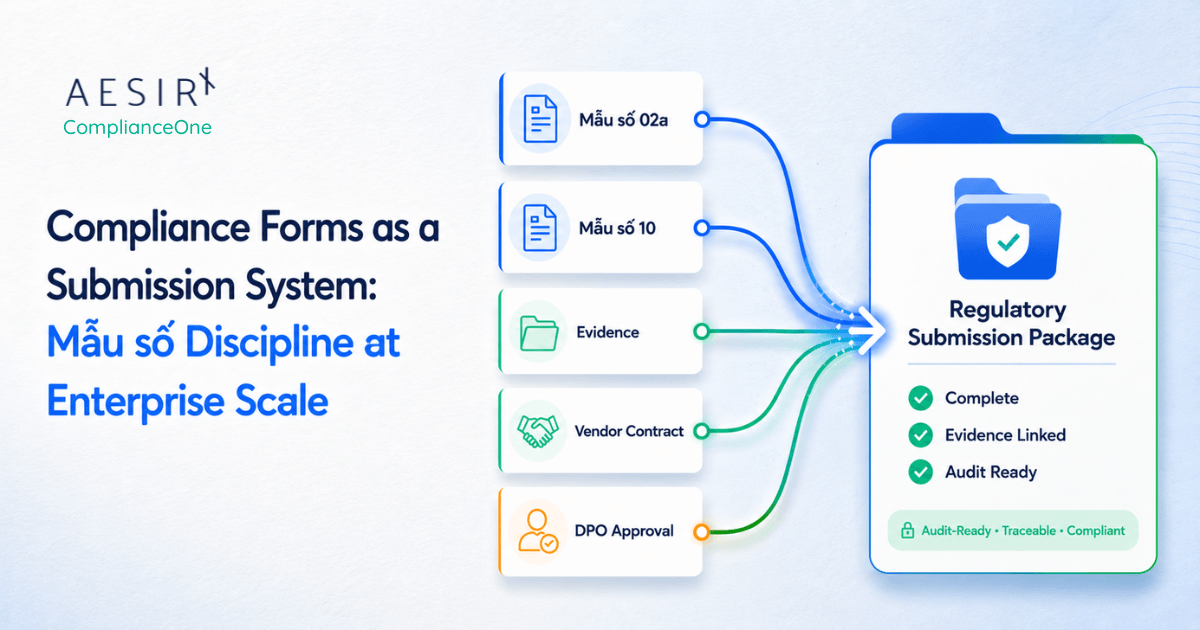
Under Vietnam's PDPL and Decree 356 regime, compliance forms are not administrative paperwork. They are structured submission packages with strict field dependencies, mandatory dossier linkages, and ongoing update triggers. When a Data Protection Officer (DPO) files a processing impact assessment (Mẫu số 02a/02b under Decree 356 Article 19) or a cross-border transfer impact dossier (Mẫu số 01a/01b under Decree 356 Article 18), the regulator evaluates the structural integrity of the submission, not just the text in the boxes.
This master class breaks down how enterprise teams transition from manual form filling to an automated submission system where form fields pull live data from processing registers, auto-calculate risk posture, and produce auditable submission packages on demand.
A compliance lead at a major financial institution sits with a 45-page document package. The Ministry of Public Security has requested an updated submission on their cross-border payment gateway operations. The lead pulls up their previous filing, drafted six months ago in a word processor. Half the third-party processors listed in the original dossier have changed their hosting locations. Two new data categories were added during last quarter's mobile app update. The signatures on the internal review cover sheet are scattered across three separate email threads.
This is the reality for most enterprise organizations operating in Vietnam today. They treat regulatory forms as static paperwork. They assign a legal analyst or external consultant to fill out text fields, export a PDF, gather physical signatures, and send the package to the regulator.
When the operational reality changes, the static document becomes instant liability.
Under Vietnam's Personal Data Protection Law (Law No. 91/2025/QH15) and Decree 356/2025/NĐ-CP, regulatory forms are not passive documents. They are statutory submission instruments. A filing under Decree 356 Article 19 (Mẫu số 02a for controllers or Mẫu số 02b for joint controllers/processors) or Decree 356 Article 18 (Mẫu số 01a for transferring entities or Mẫu số 01b for receiving entities) creates a binding legal representation of your processing operations.
When your processing operations change and your filed dossier remains static, your organization enters immediate non-compliance under PDPL Article 22 and Decree 356 Article 20, which mandate formal dossier updates whenever material changes occur.
To survive regulatory scrutiny at scale, enterprise organizations must stop treating compliance forms as documents. They must start treating them as an integrated submission system.
“A regulatory form is not a questionnaire. It is a live operational contract between your system of record and the supervisory authority.”
The Fallacy of Paperwork Compliance
The fundamental flaw in traditional compliance management is the separation between daily operations and regulatory reporting. Organizations build separate silos: engineering manages system architecture, operations manages vendor contracts, legal manages policy documents, and compliance tries to bridge all three using manual forms.
This separation creates three critical failure points in enterprise compliance.
1. The Static Snapshot Problem
When you fill out a form manually, you capture a single moment in time. The moment you save the file, system architecture begins to drift away from the document. A cloud engineer provisions a new storage bucket. A product team integrates a third-party analytics SDK. A procurement team approves a new sub-processor.
Within weeks, your filed Mẫu số 10 assessment report (the structural content backing your Mẫu số 02a/02b submission) is obsolete. When an inspector audits your processing activities under PDPL Article 35 and Decree 356 Article 31, they do not audit your intentions. They audit the gap between your filed dossier and your actual data flows.
2. The Fragmented Lineage Problem
A complete regulatory submission package consists of multiple interconnected instruments. A cross-border transfer filing under Decree 356 Article 18 requires:
- The formal submission cover sheet (Mẫu số 01a or 01b)
- The comprehensive cross-border transfer impact assessment report (Mẫu số 09)
- Supporting evidence records (data transfer agreements, recipient security certifications, impact evaluations)
- Internal review and approval records demonstrating DPO and executive sign-off
When these components are created in separate files across different departments, establishing lineage is impossible. If a regulator asks which specific version of a vendor contract supported the transfer risk rating in a filing from nine months ago, manual systems fail.
3. The Re-Filing Bottleneck
PDPL Article 22 and Decree 356 Article 20 mandate that any change in data categories, processing purposes, storage locations, or third-party recipients requires a formal dossier update (using Mẫu số 03a or 03b).
If updating a filing requires manually re-keying 80% of the original dossier, compliance teams stall. They delay updates until the next annual review, accumulating months of unnotified operational changes. This delay turns minor system updates into severe regulatory violations.
Architecting Forms as a Live Submission System
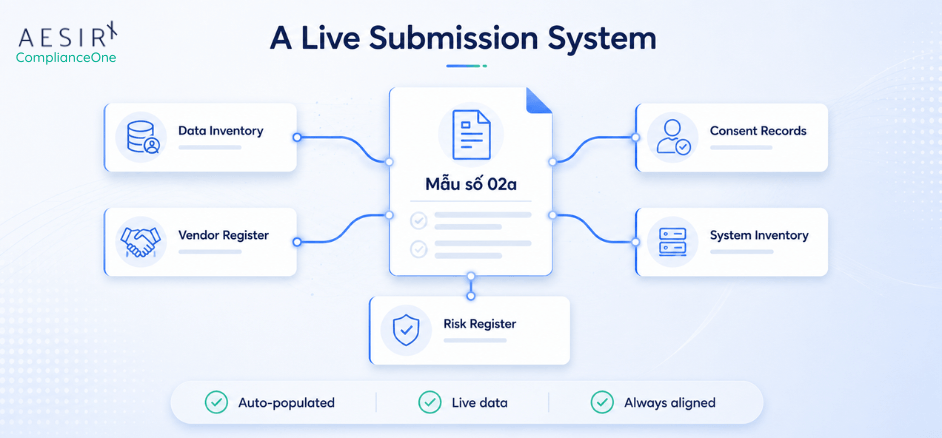
Transitioning from paperwork to a submission system requires rethinking how regulatory forms are constructed, populated, and maintained. A modern compliance platform treats forms as structured visual contracts backed by a live data engine.
Field-Level Data Mapping
Instead of asking a human to type the names of personal data categories into a form field, the form field should bind directly to your data classification register.
When constructing a processing impact dossier under Decree 356 Article 19:
- Data category fields populate automatically from your system inventory
- Legal bases map directly from verified consent records or statutory exemptions under PDPL Article 19
- Processing locations pull from active infrastructure and hosting configurations
- Retention periods bind directly to operational deletion schedules
This binding eliminates manual entry errors and ensures that regulatory terminology matches your actual data architecture.
Dynamic Dependency and Validation Engines
Regulatory forms are highly conditional. Selecting "Yes" for processing sensitive personal data (such as health, biometric, or financial location data under Decree 356 Article 4) triggers mandatory fields regarding technical protection measures, encryption standards under PDPL Article 12, and dedicated DPO oversight under Decree 356 Article 13.
A submission system enforces these dependencies dynamically:
- Required fields activate based on contextual selections
- Incomplete sections block dossier assembly before legal review
- Validation rules prevent illegal combinations (such as claiming processing without consent without citing a valid exemption under PDPL Article 19)
Automated Package Assembly and Version Lineage
A complete filing is more than a single form. It is a structured package containing primary forms, detailed assessment reports, supporting evidence attachments, and cryptographic hashes of the underlying records.
An enterprise submission system automatically compiles this package:
- The primary submission form (e.g. Mẫu số 02a) acts as the package manifest
- The backing assessment report (Mẫu số 10) attaches as a structured PDF/DOCX deliverable
- All supporting evidence (security certifications, vendor contracts, network diagrams) is auto-indexed
- The entire package is assigned a immutable version identifier and SHA-256 digest
This assembly guarantees that what you submit to the Ministry of Public Security matches your internal audit trail exactly.
Master Class: The 5 Elements of Enterprise Submission Discipline
Building an enterprise-grade form submission engine requires establishing five operational disciplines across your compliance infrastructure.
1. Schema Standardization Across All Form Surfaces
Regulatory requirements evolve, but the core primitives of privacy data remain consistent: data subjects, data categories, legal bases, processing actions, security controls, and third-party recipients.
Your form engine must use a standardized schema representation for all form templates. Whether a team member fills out a simple internal intake form, a DPIA template under PDPL Article 21, or a complex sector-specific questionnaire, the underlying fields must write to the same core data dictionary. This standardization ensures that data captured in an operational intake form automatically populates statutory filings without manual translation.
2. Role-Gated Field Authoring and Multi-Party Workflows
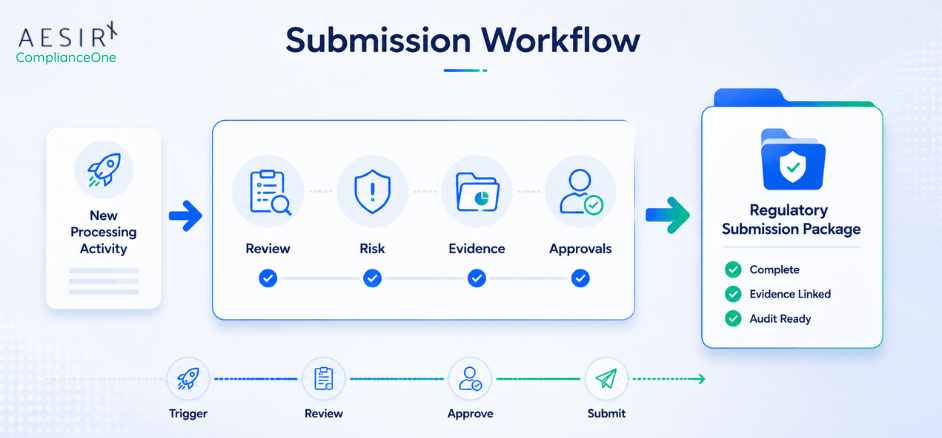
A regulatory filing is rarely completed by one person. A complete DPIA requires technical inputs from system architects, legal evaluations from privacy counsel, operational details from product leads, and final approval from the DPO.
An enterprise submission system enforces strict multi-party authoring:
- Technical leads complete system architecture and encryption sections (PDPL Article 12)
- Legal counsel reviews and approves legal basis selections and regulatory risk ratings
- DPOs review overall necessity and proportionality before signing
- Executive signatories authorize official transmission
Each contributor's inputs are timestamped and locked upon section completion, creating an immutable audit trail of internal governance before the package leaves the organization.
3. Automated Dossier Delta Calculation
When operational changes occur, the compliance team needs to know immediately whether a formal update filing is required.
Instead of manual review, the submission system runs continuous delta calculations between your active data inventory and your last-filed dossier. If a new sensitive data category is added to a processing activity, the engine highlights the exact fields in Mẫu số 03a/03b that require submission to the regulator under PDPL Article 22.
This targeted update capability reduces re-filing effort by over 80%, enabling organizations to maintain continuous alignment with regulatory expectations.
4. Bidirectional Evidence Linking
A statement in a regulatory form is only as strong as its underlying proof. If a filing asserts that all stored personal data is encrypted at rest using AES-256, that assertion must link to verifiable technical evidence.
Enterprise form engines support bidirectional evidence linking:
- Form fields carry direct references to evidence records (such as security audit certificates, penetration test reports, or key management policies)
- Evidence records maintain reverse links to every regulatory form where they are cited
- When an evidence record expires, the system flags all dependent regulatory filings for re-verification
This linking transforms static form text into a living network of verifiable compliance proof.
5. Regulator-Ready Export Pipeline
Submitting dossiers to supervisory authorities requires adherence to strict presentation standards. Reports must be formatted cleanly, include required legal declarations, and export to standard formats (PDF/A for archival preservation, DOCX for editable regulatory review).
Your form engine must decouple raw data capture from document rendering. While data is captured in structured JSON, the export pipeline renders the output into official statutory layouts complete with running headers, formal Mẫu số titles, signatory blocks, and embedded document indices.
Operational Walkthrough: Two Enterprise Submission Scenarios
To understand how submission discipline works in practice, let us examine two common enterprise scenarios.
Scenario A: Launching a High-Risk Banking Feature
A commercial bank prepares to launch an AI-driven credit scoring feature using customer transaction data and alternative financial behavioral signals. Under PDPL Article 21, Article 27(1)(d), Article 30, and Decree 356 Article 19, this high-risk processing requires a comprehensive processing impact assessment before deployment.
- Trigger: The product manager registers the new feature in the platform's project portal. The system detects automated profiling and sensitive financial data, automatically initiating a DPIA workflow.
- Data Population: The system architect links the feature to existing banking database schema. Personal data categories (transaction history, account balances, device identifiers) auto-populate into the assessment draft.
- Risk Calculation: The form engine evaluates the processing parameters against regulatory risk matrices, highlighting mandatory safeguards required for credit profiling.
- Multi-Party Sign-Off: Risk leads complete the threat assessment, cybersecurity leads verify encryption controls, and legal counsel reviews the consent mechanism under PDPL Article 9.
- Package Generation: Upon DPO approval, the system assembles the complete Mẫu số 02a submission package, generating the Mẫu số 10 impact report along with security architecture diagrams and recipient contracts.
- Filing and Archival: The generated package is archived with a cryptographic hash, establishing an irrefutable proof of compliance prior to feature launch.
Scenario B: Responding to a Data Security Incident
A telecommunications company detects an unauthorized data extraction attempt on an legacy customer portal. Under PDPL Article 23 and Decree 356 Article 28, the organization must notify the Ministry of Public Security using Mẫu số 08 within 72 hours of discovering the violation.
- Trigger: The Security Operations Center flags the incident and initiates an Incident Response workflow in the GRC platform.
- Auto-Assembly: The platform pulls affected customer record counts, impacted data categories, and system IDs directly into the Mẫu số 08 breach notification template.
- Preliminary Assessment: The incident lead enters preliminary root-cause findings and immediate containment actions into the structured form fields.
- Executive Authorization: Legal counsel and the DPO review the pre-populated Mẫu số 08 draft in a secure approval drawer, applying digital signatures.
- Timely Notification: The formatted Mẫu số 08 package is exported and transmitted to the authority well within the 72-hour window.
- Follow-Up Lineage: As forensic investigation reveals further details, the team uses Mẫu số 03a to issue structured supplementary updates linked directly to the original breach notification record.
Turning Forms into Operational Systems
When enterprise organizations transition from manual document filling to an automated submission system, compliance transforms from a legal burden into a competitive advantage.
Instead of scrambling for weeks before an audit or regulatory inspection, the DPO can generate verified, regulator-ready submission packages in minutes. Instead of fearing system changes, product teams can innovate rapidly knowing that operational updates automatically trigger targeted dossier amendments.
Compliance forms are no longer static paperwork. They are the live digital representation of your organization's commitment to data protection.
Master Class Summary and Key Takeaways
- Regulatory filings under Vietnam's PDPL and Decree 356 regime are binding legal representations. Static documents create compliance debt the moment systems change.
- Form fields should bind directly to live data classification and system inventories, eliminating manual data entry and preventing operational drift.
- Multi-party authoring workflows with timestamped section locks ensure legal, technical, and executive oversight before dossier submission.
- Continuous delta tracking between active system configurations and filed dossiers enables rapid, targeted dossier updates using Mẫu số 03a/03b.
- Automated package assembly compiles primary forms, assessment reports, evidence records, and cryptographic hashes into verifiable submission deliverables.
Explore how your organization can automate compliance filings and maintain live regulatory submission discipline: https://aesirx.io/compliance-one
Ronni K. Gothard Christiansen
Technical Privacy Engineer and CEO, AesirX.io
Laws and standards referenced
- Vietnam: Law on Personal Data Protection (PDPL), Articles 20, 21, 22, 23, and 27
- Vietnam: Decree 356/2025 (Decree 356), Articles 18, 19, 20, and 28 (Forms Mẫu số 01a/01b, 02a/02b, 03a/03b, 08, 09, 10)
- International: GDPR Article 30 (records of processing activities) and Article 35 (data protection impact assessment)
Disclaimer
This article is operational guidance from a platform vendor, not legal advice. Specific regulatory filing procedures and dossier components under Vietnam's PDPL and Decree 356 should be confirmed with qualified Vietnamese legal counsel for your specific industry sector and supervisory authority.
FAQs About Compliance Forms and Regulatory Submissions